Category Archives: Uncategorized

Community Health Work: “What do I need to know?”

A few months ago, an executive coach I’ve known since the early months of the pandemic asked me a question about the community health work I have been doing for the past several years.

“Tell me five things about working in the community that you think I should know.”

I have thought about the question and the answers I spontaneously gave him since, confident that one thing is certain: I don’t really know completely. And I know that I won’t ever completely know. So in that spirit of true humility, when asked I focused on what I was learning, and I gave it a try.

It is worth noting that I spent the first thirty of the forty years of my professional career in the U.S. Military, where everyone had a job, a house, education and access to free health care. It is clear to me now that military members are under greater stress from health related social needs than I realized while I was in uniform. Regardless, in the transition a decade ago from this successful, single-payer, government health system, the biggest wakeup call I experienced was coming face to face with the lack of the same social supports for the patients I now cared for.

For the past decade, I worked in population health as the payer systems evolved to include models of “value-based care.” Over time, it became clear that the greatest value we could provide would be to work with community partners to assure economic growth and stability, housing, transportation and food access as well as health education and seamless health care access for our patients. The individuals of the urban community where my wife and I have lived, worked and worshiped have vastly different life experiences than we do. We continue to learn from them.

Since stepping away from a hospital population health role eighteen months ago, my role has largely been in community health. Thus, my coach’s request. This is what I told him.  

 “Nothing about us without us.”  This is the first lesson we all learn. It almost seems hackneyed except that we continue to pay less attention to it than we should. The phrase has Latin roots, “Nihil de nobis, sine nobis,” popularized in Europe as the standard for establishing foreign policy and legislation. It was made popular in the U.S. in the nineties by author James Charlton, who adopted the saying from South African disability activists. The idea has been applied to a range of community organizations and efforts working alongside historically marginalized individuals and groups.

The classic (unfortunately still common) example in university settings is a grant proposal designed by academics to study members of the community without any insight from the study population along with a request for endorsement from the academic department or center imagined to be working with “them” most closely. “They” should have been a part of the conversation from the beginning.

“Initiatives in communities of color should be led by leaders of color from the community.” It is more than just “optics.”  It is a matter of better visual acuity: being able to see more clearly. There are too many things that quite simply cannot be learned or taught. These are the things that are experienced, and they are the exclusive possession of those who have lived them. That is what these leaders bring to the table, and why they should ideally have the seat at the head. No one really likes someone else’s great idea. This is especially true when the great idea is about you.

“The work may not be professionally rewarding.” In an academic setting, every lecture or seminar contributes towards promotion for junior faculty. But where on the CV do we record Sunday afternoons spent at community sites reinforcing asthma inhaler technique with children and their parents, or teaching community health providers about measuring blood pressure correctly? In terms of community research, you really can’t just study, write and publish whatever you want from the work you are doing. It’s not your data. And it’s not your story. However, in my experience, what is lacking in professional reward is more than accounted for by work that is personally rewarding.

“If you are not uncomfortable, you are probably not crossing cultural boundaries.” People from different backgrounds approach problems differently. And that can make us uncomfortable. We respond to these differences in a range of different ways. One of the ways is our response to leadership. If you’re not at least a little uncomfortable, you may not be following the community leaders. We like being in charge, especially as physicians. And whether we know it or not, we can sometimes assume and subtly communicate that we could do the job better. Or even worse, our bias leads us to unconsciously assume that a leader from a marginalized population is intrinsically less qualified to run a project than we we are. I used to wonder at times why some of my community-based peers often need to present their credentials when they enter a new public setting. Perhaps it is because of the inherent tendency of people like me to at least act like we assume they have none.

“It is a near vertical learning curve with no plateau.” I am not a rock climber, but I suspect that you can’t climb a vertical without help. Or at least you shouldn’t try. But that means we must also do the work and the preparation to make the climb. As the poet Maya Angelo said, “Do the best you can until you know better. And when you know better, do better.” In this work, we are continually learning. And the greatest risk is the assumption that we finally “understand.”

Perhaps to put it more succinctly, for those of us from outside the community, working alongside community partners for the community’s health is a lifelong journey. It is a near vertical climb where you never really arrive. You do not want to make the climb without someone who knows the mountain.

And you don’t want to make the climb alone.

Chuck Callahan Henry V 4.3 – Lead from the Front   https://henryv43.com/
2 Comments

Filed under health care leadership, Uncategorized

Bow Ties and Leader Orthopraxy

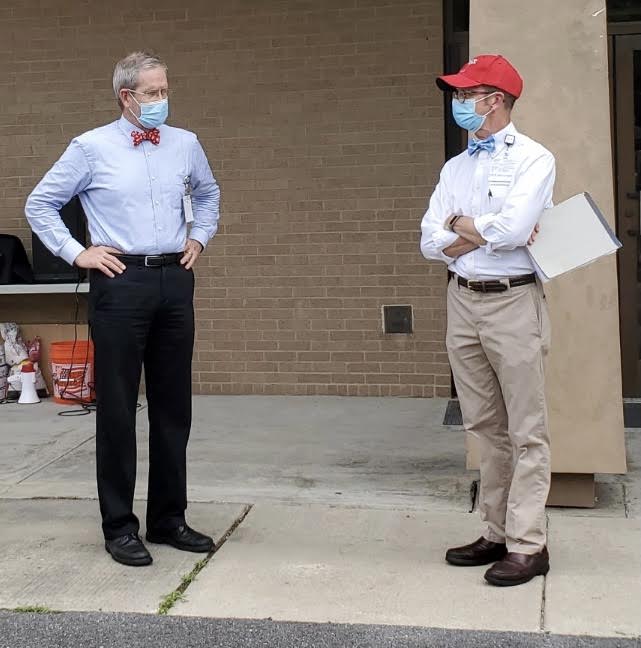
Early in our time as the Baltimore Convention Center Field Hospital (BCCFH) COVID Contingency hospital I started wearing a bow tie to work every day. My co-director Dr. Jim Ficke and I made the decision together and it became something of a trademark for us as we worked in the various testing, vaccination and treatment sites across Baltimore and Maryland. We joked with the staff that if anyone had a complaint, they should tell them to look for one of the guys with a bow tie. We got plenty of feedback from our patients. But it was largely compliments about our team rather than criticism. Several of the other executive leaders also wore bow ties as they came on board. They thought it was part of the uniform.

The tie is part of a larger set of lessons about professionalism that I have been learning throughout my health care career. A med school professor told me that he never wore blue jeans to the hospital because he didn’t want to create too casual an impression with patients. Since then, I haven’t either. I started wearing bow ties as a medical student when I decided on a career in pediatrics because I thought they were less likely to get urinated on than a neck tie. (The latter have been suspected of carrying pathologic bacteria. Though disputed, it’s another reason for a bow tie preference). Continue reading

Leave a comment

Filed under Organizational Leadership, Uncategorized

The Bat-Phone and Leader Presence

Recently I had the opportunity to speak to the mother of an infant hospitalized with respiratory illness in a hospital in another state. She was the daughter of a friend of a relative but it was a joy to speak to her, talk through some of her concerns and reassure her that from what she was telling me, she was in good hands. (Her baby did well!)

In the course of the conversation, I remembered that I knew a senior physician at the hospital and I send him a quick text. By the time I caught up with him a little while later, he had already been to the patient’s room. He missed the baby’s mother but left his card with his cell-phone number in case she needed anything.

His generous gesture reminded me of the “Bat-Phone” we instituted when I was a hospital CEO (Commander) a decade or so ago. I am relatively sure that I stole the idea from Quint Studer or another of the quality and patient experience gurus to whom we owe so much of the great things we were able to do at that facility while we were shaping a “Culture of Excellence.” We shared the Bat-Phone cell phone number with all of our staff, our hospitalized and ambulatory patients – probably thousands of people. I carried the phone with me every day. It was a visible symbol of our efforts to be accessible to our staff and patients. In addition to the phone number, we also had a link on our public and internal websites where people could reach out to the CEO by email directly. Continue reading

6 Comments

Filed under General Leadership, Personal Leadership, Uncategorized

“Of course!”


A PICU nurse said that to me recently. We had just finished doffing and were walking out of the hot zone transition area of the Convention Center COVID field hospital where we worked. We struck up a conversation and at the end of our exchange I thanked her for serving these patients with us. “Of course!” was her reply.

I think I have heard that response more often these days. Perhaps it is cultural or generational (millennial?). Or maybe it’s just a new colloquialism characteristic of the times. I can’t recall whether it was as common before COVID as it seems to be now. But maybe I should just blame that on “COVID time.” (It seems I can’t remember a lot of things from before COVID.)

In the case of this nurse the “Of course!” took on special meaning. We talked about our shared experience working in pediatric intensive care and the special calling it takes to be a nurse in that setting. She told me that she loved taking care of critically ill children, but when this contingency COVID hospital was established she wanted to be a part of it. The unit where she worked couldn’t allow her go to part-time, so she resigned. And she has been a part of caring for the more than 1,300 adults with COVID we have admitted in our past year or so of operation.

She left something she loved to be part of something she felt needed to be done.

In his mid-twentieth science fiction novel “Starship Troopers” (Putnam 1959), Robert Heinlein wrote “Duty is the social equivalent of self-interest.” It is “the basis of all morality.” It strikes me that duty was not something we heard as much about before the pandemic. Attention and devotion to duty seem to be common virtues now. Continue reading

Leave a comment

Filed under Uncategorized

“Is this your field hospital?”

“Is this your field hospital?”

This question is the reason I wear a tie to all our COVID testing events. I want people to know where they can direct complaints or concerns. I walked over to the gentleman who asked the question and steeled myself for “constructive feedback.”

It has been six months of almost exclusively COVID. Since mid-winter and my taking the role of Hospital Incident Command’s “Community Liaison,” the population health job has taken on a very specific focus as COVID has become the latest of the threats to the health for our community.

We started in early March by planning for hospital COVID testing and working with community health on food distribution after the schools closed and many of the children in the community lost access to several of their daily meals. By mid-month, a group of us from the two largest medical systems in our city met with the State Health Department and were directed to construct and operate a FEMA field hospital in the convention center. Continue reading

6 Comments

Filed under Organizational Leadership, Uncategorized

Entering another’s story

At the height of the war in Iraq and Afghanistan, I had the opportunity to escort a number of celebrities, “suits” (politicians) and “stars” (generals/admirals) when they visited the wounded, ill and injured soldiers in the Army hospital where I was the chief medical officer. On one such occasion I had the privilege of accompanying the late Senator John McCain on a visit to present a purple heart medal.

He came out of the car with a gruff, all-business demeanor that continued as we walked to the conference room and I briefed him on the soldier and his family. His face transformed into a warm smile as he walked into the room.

The family was from a small town in the south.
“Isn’t there a famous BBQ place there?” the senator asked, and mentioned the restaurant by name.
The family was dumbfounded.
“How did you know that?” they asked him.
“Remember the campaign for president,” he replied with a grin. “I ate a lot of BBQ.”
He instantly connected with the soldier and his family as he entered into their story.

The American poet Muriel Rukeyser wrote, “The universe is made of stories, not of atoms.” The older I get the more I find myself enamored with my own story and its associated yarns, (my wife knows them all by heart), and the more my autobiography seems to become my most oft referenced book. I am as facile with the first person singular as anyone. It is something I am very aware of and so am sensitive to it when I notice it in others.

It is also something I have watched successful, respected leaders intentionally avoid. I have come to the conclusion that they are able to do it by actively engaging and entering into others’ stories. In practical terms it means being present, paying attention and being intentional. It is often driven by the art of the second question:

“How are things going?” you ask a subordinate on executive rounds.
“Fine.”
“What do you mean by ‘fine?’”

Rather than using another’s comment as an excuse to open the pages of my autobiography and drag another unwilling victim into its pages and personal lessons, through careful, thoughtful, open-ended questions, eye contact and engaged body language (leaning forward, mirroring their facial expressions with my own) I am invited into their narrative and become a part of their story.

It doesn’t take much. More than thirty years ago, I remember running into a senior nurse who was visiting the hospital where I worked. I had met her only once previously a few years earlier when I was still in training . She remembered our meeting and in fact greeted me by name. With just a brief encounter in a hospital hallway she became part of my life’s story; a model of the kind of leader I hoped to become.

At home with my wife and children, this should mean the practice of “Your day goes first” when we gather after work and school. My mother was so good at this when I was a boy that I grew up thinking that my story, my day was more important than anyone’s. It has been a hard habit to break. When I was a college freshman, I distinctly remember a mentor requesting of me after several of our one-on-one meetings, “Why don’t you ask me how I’m doing; how my week has been?”

I am aware that I have been woefully inadequate at this practice. A decade ago, at yet another dinner where I was talking about the particulars of my 40-mile, 60-minute commute, one of my teenage daughters said without looking up from her meal, “You know Dad, no one really cares about this.”

The story goes that Winston Churchill’s mother Lady Jennie Jerome Churchill dined in the same week with two of the greatest leaders in England at the time, Benjamin Disraeli and William Gladstone. A journalist asked her impression of the two men and she replied, “When I left the dining room after sitting next to Gladstone, I thought he was the cleverest man in England. But when I sat next to Disraeli I left feeling that I was the cleverest woman.”

Apparently, Disraeli wanted to learn all he could about Lady Churchill; he asked her a series of questions and avoided my own tendency to relate everything back to my own story. It is a practice that can be learned – with attention and intention.

I walked Senator McCain back to his car after he made his purple heart presentation. As we reached the curb, I told him that I had recently read his book, “Character is Destiny.”
“Really?” He looked up and made eye contact.
I told him that my favorite chapter was his story from a Christmas morning when he was a prisoner of war at the Hua Lo prison in Hanoi.
“Christmas at Hua Lo…” his voice trailed off and he looked past me; briefly focused elsewhere. I continued to look into his eyes. He glanced at me again, smiled, turned a moment later and climbed into his car.

I remember standing for a few seconds after he drove away savoring the privilege of having shared the story of one of America’s greatest heroes with him, even briefly.

Then as now I was reminded that the privilege of entering another’s story requires the willingness to leave my own. It is an honor even for a moment, and over time I have become convinced that,“Life is measured in moments like these” (Maggie Stiefvater).

Chuck Callahan Henry V 4.3 – Lead from the Front   https://henryv43.com/
6 Comments

Filed under Uncategorized

When “a lot” can be “too much.”

“Do not reap to the very edges of your field…” (Leviticus 23:22)

I came across this Old Testament reference during an early stint in hospital leadership a decade or so ago. Then as now I occasionally vexed my wife by splitting hairs around the subtle difference between saying “It’s too much” when considering the weight of family, work and calendar stress and saying “It’s a lot.” One makes the challenges sound insurmountable, while the other leaves the possibility that we could still squeeze a few more things into the schedule. (Hence the vexation.)

My reflex is to go with “It’s a lot” rather than “it’s too much,” but there is no question that there are “too much” times in life; times when we need to take a tactical pause and figure out what needs to change.

Thirty years ago I hiked the Grand Canyon wearing boots that were too small (very painful on a continual downhill slope). After about twelve hours I reached the point along Bright Angel Creek that I told my friend I couldn’t go another step. It was a first for me. The first time in memory where I had reached a limit to what I was physically and mentally able to do. We camped just off the trail that night before heading back the next morning. Staring up at the stars on that cloudless night I thought a lot about margins and edges.

At the time, I was leaving general pediatrics, relocating my family across the country, entering into a fellowship in pediatric pulmonology, and I had already started plans to simultaneously get a masters degree in health administration from Temple University.

That night I resolved that it would all probably be too much. And the next day on the trail when we struck up a conversation with other hikers who just happened to be students in Temple’s MHA program, I bit my tongue and didn’t tell them that I’d soon be joining them. (Some things you just can’t make up.) I let the idea go. It was a fortunate decision. The fellowship was more rigorous than I had imagined, my father declined rapidly and died from cancer in that three year window, and we had the surprise birth of our first set of twins. I am thankful for the persuasive influence of those too-small boots.

The passage in Leviticus further explains why the corners of one’s field should be left unharvested: “Leave them for the poor and for the foreigner residing among you.” The harvest and gleanings at the edges of the field were for the needy in Biblical times. And they represent a primary reason for leaving margins in our own lives as leaders. We cannot always anticipate who will need us; when we will need to be present and available for others particularly for family members who often have the most difficult time “getting on our schedules.” Early in parenting I abandoned the idea of thinking that I could schedule quality time with our kids. Instead I learned that we need to just “Be there,” echoing lion-tamer Gunther Gabel-Williams advice to his son about climbing into a lion cage. I wish I had been there more.

We also need to leave a little at the edge for ourselves. Like the too-small boots in the Grand Canyon episode, there will be times when “a lot” becomes “too much,” the schedule becomes too tight and we will need to recover. Better to have those times of rest, hobby or relaxation anticipated and scheduled than to have to cancel or shuffle other things to find the time to squeeze them in.

The margins are for others and for self.
They won’t be available to either if we reap to the edge of our field.

Chuck Callahan Henry V 4.3 – Lead from the Front   https://henryv43.com/

4 Comments

Filed under Uncategorized

Rethinking the public’s health: The case for a Public Health Service enlisted corps

The U.S. Public Health Service (PHS) was established more than 200 years ago to support national efforts to assure the health of the American population. Before the advent of the antibiotic era in the first half of the last century, health was largely defined as the control of infectious diseases and accident prevention. Public health policy comprised efforts to confine contagion, prevent epidemics and promote practices that improved public safety.

The availability of antibiotics and widespread vaccination campaigns of the last century diminished the potential of infectious diseases to shorten life expectancy. Since then, Americans have lived longer. And with longer lives we are more likely to suffer the long-term consequences of increasingly common chronic diseases such as hypertension, heart disease, cancer and diabetes. Our Western diet, use of tobacco, and exposure to environmental insults that have resulted from industrialization have increased the prevalence and deleterious impact of these diseases.

In recent years American healthcare providers are awakening to the idea that health is more than the absence of disease. Dr. Lester Breslow was one of the most influential proponents of public health in the United States over the past century. In his nearly 70-year career, he described the evolution of the public health from merely disease and accident prevention to the idea of active health promotion. A career researcher, he demonstrated the importance of simple practices such as getting adequate sleep, exercise, and nutrition, moderating alcohol consumption and maintaining weight within recommended parameters to reduce the impact of chronic disease, increase longevity, and improve overall health.

However, there is a tension between the lifestyle health benefits championed by Breslow and the factors that prevent large sectors of our nation from realizing them. We increasingly recognize the potential adverse effect social determinants have on individual and population health in our communities—factors that include income below the poverty level, inadequate housing, lack of education, low literacy, unavailable transportation, and dangerous environmental conditions. Much work remains to be done. But there are too few to do the work. Continue reading

Leave a comment

Filed under Uncategorized

The ED, The City, and the Job To Be Done

Despite all of our efforts over the past decades to build medical homes for our patients and families and to connect them to their new homes, people still choose emergency rooms (ERs) for ambulatory care.

As an example, in a study utilizing the National Hospital Ambulatory Medical Care Survey (NHAMCS) and the National Hospital Discharge Survey (NHDS) to assess hospital-associated healthcare between 1996 and 2010 in the US, the number of ER visits increased by 44%, resulting in an average 48% of contacts (comparing hospital outpatient departments, emergency departments, and ambulatory surgery sites).

In this study the rise was significantly greater in African-American populations, Medicare and Medicaid recipients and in women, emphasizing the important use of ERs by traditionally vulnerable, urban populations (Marcozzi et al. Intern; Int J Health Serv. 2018;48:267-288). In Baltimore City there were 52 ER visits/1000 patients per month and 28/1000/month in the State of Maryland as a whole in 2018 (CRISP). Earlier studies using the ecology of health care model suggested a generalized rate of 13/1000 ER visits per month for the US population (Green et al. NEJM 2001;344:2021-2025). It seems that people are choosing ERs more often. Continue reading

1 Comment

Filed under Uncategorized

“The Service” & the Social Determinants of Health

In presentations I have made in the past year or two I have had to confess to a relative inexperience and unfamiliarity with the social factors that can adversely affect a population’s health and well-being.

My inexperience is the result of having spent nearly my entire medical and leadership career practicing in the military medical system. Until recently my patients, their parents and families were all active duty or retired military. As a group they had education, jobs, housing and access to healthcare. We know that only about 20% of what makes our patients well or not is a result of health care (despite our inclination to think that those of us in health care are located at the center of the wellness universe). For the remaining eighty percent of what influences health and well-being, our military patients had the benefit of the positive effect of education, jobs and housing. Continue reading

3 Comments

Filed under General Leadership, Uncategorized