Category Archives: Organizational Leadership

The case for a cowboy.

For the last several years, I have been using Dr. Atul Gawande’s graduation speech to the Harvard Medical School Class of 2011 (“Cowboys and Pit Crews) in teaching about the evolution of health care delivery I have witnessed over my years in practice.

When my medical career began (during Reagan’s first presidential term), hierarchical “parallel mono-disciplinary” care was the typical patient’s experience, where a patient was passed between specialists and hospitals until someone (hopefully) took the time to sit down and listen to their journey, piece together the story, mine the available paper records and validate the patient’s concerns with a reasonable differential diagnostic and therapeutic plan. This pattern of care delivery continues in many settings today.

In the closing decades of the last century we moved forward considerably with multidisciplinary (multiple specialties looking at the same patient at the same time, often in the same clinical space) and interdisciplinary teams (multiple specialties looking at the same patient at the same time, including the voice of patient and family, and agreeing on a single patient and family-centered set of treatment goals).

More recently, we have increasingly recognized that health is more than the absence of disease. The true drivers of health are determined by the 8,759 hours a year our patients spend at home in their community rather than the roughly one hour a year the average American spends in a provider’s office. In the future, the individual and population’s health will be addressed by a new model of integrated, community-care teams that include health care professionals but also community navigators and service providers as equal partners who are able to address issues like housing, food security, employment and economics. (But that’s the subject for another post.)

Time has proven that Dr. Gawande was right. The future of health care depends on our ability to function like pit crew teams with broad, horizontal, flexible, situational leadership structures.

But for the past several weeks, I wish we had a cowboy.

Not long ago, a close family member was diagnosed with an aggressive, fatal condition. Unfortunately, we had to derive some of that diagnosis and prognosis from our own research, from combing through the on-line patient portal, using search engine AI and by reaching out to physicians through the “doctor-to-doctor” informal communication system.

The ambulatory provider who had cared for this family member for decades was not a part of the hospital team. The inpatient health care team members were attentive and empathetic. The leader of every team—nursing and physician—met with us. But no one seemed to be willing to address the bigger picture.

I know from my many years practicing pediatric intensive care that there is no joy in delivering terrible news. I recognized in myself long ago the subconscious tendency to avoid this unpleasant, uncomfortable task. I doubt I am alone. And so, we are all at risk to abrogate (“evade a responsibility or duty”) and thus abdicate (“fail to undertake a responsibility or duty”) when it comes to sharing bad news.

This can be compounded by aspects of team-thinking, including a tendency to defer to other specialties when higher-level conversations are needed. The trend towards “super-specialization” may contribute to the practice of leaving some of the tough conversations surrounding death and dying to the palliative or hospice care teams. But they should be invited into the treatment team after these difficult conversations have taken place and not before.

As strangers to the hospital and staff, what we needed was one person.

What we were missing was a cowboy.

We did not need the old-school bluster, swagger, arrogance or patriarchal condescension that occasionally characterized physicians of my era and before. For example, I was told that just before I started my first job in the seventies as a hospital technician in a coronary care unit, the nurses were expected to stand when the senior physician walked onto the unit. That’s not the kind of “cowboy” we were looking for.

We needed a consistent, straight-shooting clinical leader who helped prepare us as a family to make difficult decisions about our loved one’s treatment and outcomes; one voice to whom we knew we could turn over the weeks that this disease took its toll and perhaps even beyond, when the inevitable second guessing becomes an element of grieving. It could have been a person from any specialty. While the hospital inpatient physician and nursing teams justifiably rotated on a daily and weekly basis, we needed someone whom we saw every day, who checked on us and helped us understand the evolving clinical situations in the context of the bigger picture.

Hospitals are infinitely safer, more compassionate, and better organized than when my medical career began in the eighties. The evolution, promulgation and proliferation of healthcare teams has without question been a key driver of these improvements. We would no more go back to the stoic, isolated, aloof physician as sole decision maker than we would give up the electronic medical record to return to paper and pen.

Health care teams are the future of medicine, in clinical settings and in the community.

But sometimes, at specific points across the span of life, we still need consistent, visible leadership.

I think we still need cowboys.

Chuck Callahan Henry V 4.3 – Lead from the Front   https://henryv43.com/
7 Comments

Filed under health care leadership, Organizational Leadership

Bow Ties and Leader Orthopraxy

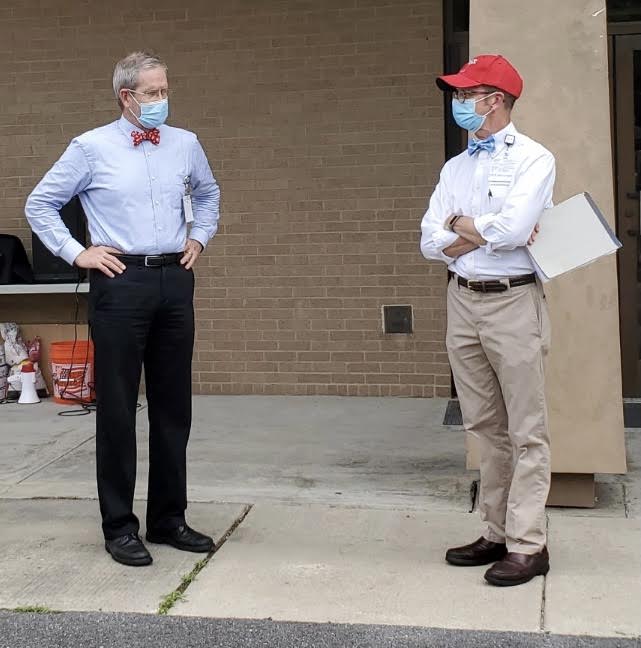
Early in our time as the Baltimore Convention Center Field Hospital (BCCFH) COVID Contingency hospital I started wearing a bow tie to work every day. My co-director Dr. Jim Ficke and I made the decision together and it became something of a trademark for us as we worked in the various testing, vaccination and treatment sites across Baltimore and Maryland. We joked with the staff that if anyone had a complaint, they should tell them to look for one of the guys with a bow tie. We got plenty of feedback from our patients. But it was largely compliments about our team rather than criticism. Several of the other executive leaders also wore bow ties as they came on board. They thought it was part of the uniform.

The tie is part of a larger set of lessons about professionalism that I have been learning throughout my health care career. A med school professor told me that he never wore blue jeans to the hospital because he didn’t want to create too casual an impression with patients. Since then, I haven’t either. I started wearing bow ties as a medical student when I decided on a career in pediatrics because I thought they were less likely to get urinated on than a neck tie. (The latter have been suspected of carrying pathologic bacteria. Though disputed, it’s another reason for a bow tie preference). Continue reading

Leave a comment

Filed under Organizational Leadership, Uncategorized

Imperatives of Leadership: A Pandemic Response

“We few, we happy few, we band of brothers…”

The name of this website was inspired by an article on leadership based on two books by Sandhurst military historian John Keegan. The Face of Battle was his 1976 analysis of major battles in history including Agincourt (October 27, 1415). His 1987 book The Mask of Command highlighted styles of military leadership through history and concluded with five of what Keegan considered to be the “Imperatives of Leadership:” kinship, prescription, sanction, action, and example. The 1998 article examined Shakespeare’s speech by Henry at Agincourt (Henry V, Act 4, Scene 3) as an example of Keegan’s leadership imperatives.

In the early spring of 2020 as the COVID pandemic gained momentum, US Army Colonel (Retired) Dr. Jim Ficke and I were asked at the behest of the Governor to stand up a field hospital in the Baltimore Convention Center with a number of leaders from Johns Hopkins Medicine, the University of Maryland Medical Center and the Maryland Department of Health.

Fifteen months later the team concluded inpatient operations after providing care for 1,495 inpatients with COVID. Along the way (and often with short notice) we added missions including a mass COVID testing capability and later numerous community sites that have performed more than 110,000 tests to date. Monoclonal antibody infusions were added in the autumn of 2020 and more than 2,300 have been provided since. And finally, when vaccines became available,  a large-scale vaccination center was opened that has provided more than 122,000 vaccinations since February 2021. The Baltimore Convention Center Field Hospital (BCCFH) is almost certainly the longest continually operating convention center COVID hospital in the nation, and probably the only one where the same team also provided ambulatory infusion treatment, large scale COVID testing and vaccination.

In retrospect, Keegan’s imperatives of leadership were the standard as we established and operated the hospital. In many ways, they were key elements of its success. Continue reading

3 Comments

Filed under Organizational Leadership, Personal Leadership

“Is this your field hospital?”

“Is this your field hospital?”

This question is the reason I wear a tie to all our COVID testing events. I want people to know where they can direct complaints or concerns. I walked over to the gentleman who asked the question and steeled myself for “constructive feedback.”

It has been six months of almost exclusively COVID. Since mid-winter and my taking the role of Hospital Incident Command’s “Community Liaison,” the population health job has taken on a very specific focus as COVID has become the latest of the threats to the health for our community.

We started in early March by planning for hospital COVID testing and working with community health on food distribution after the schools closed and many of the children in the community lost access to several of their daily meals. By mid-month, a group of us from the two largest medical systems in our city met with the State Health Department and were directed to construct and operate a FEMA field hospital in the convention center. Continue reading

6 Comments

Filed under Organizational Leadership, Uncategorized

Diversity: Beyond optics to vision.

It was relatively late in my leadership career when the concept of diversity became something we started talking about. (Or perhaps I just wasn’t paying attention before then.) Mandatory diversity training was directed by the organization I was a part of and I don’t remember thinking much of the information. I don’t think I got it.

A few years later in a CEO role I recall a conversation with a younger, African-American member of our staff who became a mentor to me. She was the first to suggest to me the potential role of implicit bias in our employee evaluation process. At first, I pushed back. But I can remember the feelings as her words sank in and I realized she might be right: about our organization and about me. It was a significant emotional moment. I remember where I was standing in my office.

What she said resonated with a concept I had long believed. It was best summarized in an article I stumbled across about an obscure lung disease early in my pulmonology career: “We see only what we look for; we look for only what we know” (Sosman MC, et al. Am J Roentgenol Radium Ther Nucl Med 1957;77:947-1012). We don’t see what we’re not looking for. I think I was beginning to get it.

As the hospital’s senior leader I noticed that most of the faces around our board table looked just like mine; consistent with about 85% of all hospital executives. Our organization and our patients had a very different demographic and I began specifically looking for leadership candidates who did not look like me in race or gender. I had resolved that it was a matter of bad “optics.” At a minimum, a leadership team that doesn’t reflected the diversity of the organization won’t inspire young leaders from different groups to seek positions of responsibility.

But just settling with optics as the reason for diversity also makes the fundamental mistake of assuming that people who look alike are alike. It assumes that all you need to achieve diversity in leadership is to add people who are different than the majority to make the team look good. But you can have bad optics with a team that looks bad or with a team that merely looks good for the sake of appearance. I realize now that I was missing the point about optics.

It was sometime later, perhaps after working in Africa a few times and then settling into a neighborhood where I am the minority that I feel like I am finally beginning to understand.

The lack of diversity in healthcare leadership is a matter of optics.
But it’s not a matter of looking bad. It’s a matter of seeing badly.

A diverse representation of demographic groups and gender at the executive table brings the ability for the entire leadership group to see the issues of the workforce, the patient population and “customers” more clearly and in ways that would be impossible without the range of perspectives.

Diversity is the lens through which the leadership team can look more deeply into the challenges and experiences of a particular group and community (microscopic) and can look farther into the future in envisioning better ways to address the populations’ challenges (telescopic). Inclusion is the willingness and openness of the team to look through all of the different lenses.

I guess I was right about the optics, but was initially wrong about vision. I am still pretty shortsighted at times and I will never say that I completely “understand” or that I get it. That is a conclusion best drawn by others.

But things are becoming clearer.

Chuck Callahan Henry V 4.3 – Lead from the Front      https://henryv43.wordpress.com/

3 Comments

Filed under General Leadership, Organizational Leadership, Personal Leadership, Uncategorized

Lead from the front or from the back?

A young colleague asked me recently how a leader reconciles the challenge to “lead from the front” with the recognition that much of the most effective leadership happens “from the back” (a lesson I recognized and attempted to articulate relatively late).

My own leadership journey was shaped as a 22 year old infantry officer. I was inspired by the sign over the door of the Ft. Benning infantry school way back when we were still waiting for Ivan in the Fulda Gap: “Lead, follow or get the hell out of the way.” The school motto is “Follow Me.” With that as background (and the subtitle of this blog site) this tension between back and front struck me as a topic worth considering and provided the chance to write (after an embarrassingly long silence!) And it made me think of Julius Caesar.

“Omnia uno tempore agenda” (“Everything had to be done at once”) is how in his “Gallic Wars,” Julius Caesar described his response to an attack by the Nervii, the fiercest of the Belgic tribes of Northern Gaul in modern day northern France (57 BCE). The attack came at three different points while part of his army was crossing a river and another part was building camp. Caesar describes in characteristic third person “the stress of the moment:”

“Caesar had everything to do at one moment — the flag to raise, as signal of a general call to arms; the trumpet-call to sound; the troops to recall from entrenching; the men to bring in who had gone somewhat farther afield in search of stuff for the ramp; the line to form; the troops to harangue; the signal to give. A great part of these duties was prevented by the shortness of the time and the advance of the enemy…” (II.20).

Caesar details a time of crisis. There was tremendous risk of failure and destruction to his army and to his mission. He describes the chaos that is characteristic of the heat of battle. And he describes “the shortness of time” or “chronos” (“time” in ancient Greek).

At one point in the battle, his Twelfth Legion was in trouble, fighting too closely bunched together, and without many of their small unit leaders (centurions) who had been lost to wounds. Caesar describes his own response to the crisis, chaos and the time-pressure of “chronos:”

“He perceived that his men were hard pressed … he likewise perceived that the rest were slackening their efforts … having therefore snatched a shield from one of the soldiers in the rear (for he himself had come without a shield), he advanced to the front of the line, and addressing the centurions by name, and encouraging the rest of the soldiers, he ordered them to carry forward the standards and extend the companies, that they might the more easily use their swords…” (II.25)

This was a time for the leader to lead from the front. Caesar demonstrated character and courage by personally assuming the risk of failure and death. He demonstrated leader competence by recognizing that his troops were leaderless and faltering: “He perceived that all the centurions of the fourth cohort were slain, and the standard- bearer killed, the standard itself lost… He likewise perceived that the rest were slackening their efforts, and that some, deserted by those in the rear, were retiring from the battle and avoiding the weapons” (II.25).

Caesar recognized the context of the fight with the loss of the leaders, also seeing that they were crowded together in the forest, and “That the affair was at a crisis, and that there was not any reserve which could be brought up” (II.25). And he recognized the critical importance of communication. He called to his centurions “by name;” relying on efforts he had made to know his men personally prior to the battle (having perhaps abandoned the too convenient excuse, “I’m sorry I’m just not good with names”). He called out and encouraged the rest of the soldiers. He knew exactly what they needed to hear.

Crisis, chaos and “chronos” are three occasions when a leader should lead from the front.

Caesar also identified at least two occasions when it is appropriate even in the midst of urgency to lead from the back.

“The stress of the moment was relieved by two things: the knowledge and experience of the troops — for their training in previous battles enabled them to appoint for themselves what was proper to be done as readily as others could have shown them — and the fact that Caesar had forbidden the several lieutenant-generals to leave the entrenching and their proper legions until the camp was fortified. These generals, seeing the nearness and the speed of the enemy, waited no more for a command from Caesar, but took on their own account what steps seemed to them proper” (II.20).

The Roman legions were well trained and well led by commanders that Caesar trusted; who applied their own initiative and creativity to the situation and did “on their own account what steps to them seemed proper.” Even in crisis and chaos, leaders need to lead from the back when they know that their organizations are well trained and that they are led by men and women whom they trust. The temptation to micromanage a project or its architect and to take credit for its success are ways that a leader can move “to the front” when it would be best for him or her to step back and let the group or emerging leader shine.

The use of Caesar’s writing about his imperial exploits is not meant to justify the geo-political drive to conquest any more than it would be to use the example of corporate raids or take-overs motivated by greed. But leaders with any experience know that it only takes a single organizational misstep and social media post or market fluctuation to suddenly create a time-pressed, chaotic, crisis.

It is nice to be able to write your own history. (Is this account the ancient equivalent of a modern-day CEO memoir?) Caesar concludes with what we would hope to realize from our own leadership efforts: “On his arrival, as hope was brought to the soldiers and their courage restored, while everyone for his own part, in the sight of his general, desired to exert his utmost energy, the impetuosity of the enemy was a little checked” (II.25).

The enemy’s impetuosity was “A little checked;” at least for a day.

Tomorrow will be another opportunity to find the balance between leading from the front and from the back.

Chuck Callahan Henry V 4.3 – Lead from the Front https://henryv43.wordpress.com/

2 Comments

Filed under Organizational Leadership, Personal Leadership

Play like you have nothing to lose.

“How many of you have ever worked for a bad leader?”
(Every time I ask the question almost everyone raises a hand.)

“What made him or her a bad leader?” I usually ask. You hear a number of different responses. Occasionally someone will talk about a truly toxic leader. But most of the time the common answer is more like this:
“They only cared about themselves.”

“And how long did it take you to figure that out?”
“About five minutes,” I have heard more than once.

I wondered today whether the common problem with these self-concerned leaders is the inability to play like they had nothing to lose.

Frankly, as leaders we always have something to lose. When we make the hard call, stand by our people, serve as “poop-umbrellas” absorbing or deflecting the “stuff” that sometimes rains from on high we run the risk of everything from taking heat to losing our job or reputation. Which brings me to the events of the past couple weeks.

I confess I have had to resist joining the throngs who have written about the recent Eagles Super Bowl victory, especially as a fan for almost half a century; onephiladelphia_eagles_logo_4008 who remembers clearly the many “almost made its” and “there’s always next years” that have become the stock jargon of Philly fans. But indulge me as I can’t help but think that there is a leadership lesson in their victory this year.

Who goes for it on fourth and goal from the one yard-line just before the half with a trick play that they’ve never run before; throwing to a guy who hasn’t caught a pass in a game since high school? What coach listens to the players on the field and takes a gamble that if it had failed and they ultimately lost the game would have been the play every pundit would point to as the moment of supreme mistake, ultimate error, the deadly “momentum changer” that doomed the game to defeat.

But even after watching and re-watching the clip and listening to the recorded dialogue, I don’t get any sense that there was a fear of taking heat, losing job or reputation as the decision was made.

They seemed to be playing as though they had nothing to lose.

It’s easy to understand why a leader might do otherwise. A politician works hard to get elected and becomes motivated to remain in office. A healthcare administrator works her whole life to become a hospital CEO. An officer begins the journey to general as an ROTC cadet. A teacher gets his masters then doctorate with the hope to one day become a principal and then the day finally comes. The next in line for corporate CEO is competing with scores of others. A coach or player is finally in the Super Bowl…

I wonder sometimes whether the fear we take counsel of is ultimately the fear of loss to self. And whether we can too quickly allow that fear to keep us from taking the risks we must to achieve organizational success. Certainly, there is much at stake. But Teddy Roosevelt has advice for every leader who is willing to get into the arena:

“It is not the critic who counts; not the man who points out how the strong man stumbles, or where the doer of deeds could have done them better. The credit belongs to the man who is actually in the arena, whose face is marred by dust and sweat and blood; who strives valiantly; who errs, who comes short again and again, because there is no effort without error and shortcoming; but who does actually strive to do the deeds; who knows great enthusiasms, the great devotions; who spends himself in a worthy cause; who at the best knows in the end the triumph of high achievement, and who at the worst, if he fails, at least fails while daring greatly, so that his place shall never be with those cold and timid souls who neither know victory nor defeat.” (April 23, 1910)

This week the credit belongs to a team of leaders who played as though they had nothing to lose and won.

Next week the same opportunity may be ours.

Chuck Callahan Henry V 4.3 – Lead from the Front      https://henryv43.wordpress.com/

1 Comment

Filed under General Leadership, Organizational Leadership, Personal Leadership, Uncategorized

Population Health: Capital and Lower Case “P”

The term “population health” entered my vernacular in the late nineties when I was a new pediatric department chief and our hospital director of quality introduced me to the term. Like most clinicians I was a pretty good medical “tactician” in the ICU, the clinic, and on the hospital ward. But I didn’t consider the bigger “strategic” outcomes of groups of patients often enough. This changed.

The department and hospital took on pediatric asthma in our population and saw the hospitalization rate for our patients drop by two thirds. (In fairness, it was also the beginning of the era of “asthma control” so there were more tools available.) We championed telemedicine systems that provided pediatric subspecialty consultation for children six time zones and thousands of miles away and monitored children with asthma in their homes over the relatively new Internet. After helping to run health care facilities and systems for the Army and working in a few health care systems overseas, I was fortunate to begin work as a hospital executive focused on population health in an urban medical center.

These past two years I have been mentored by health care and community leaders regarding the impact of the social determinants of health (e.g. housing, education, food security, jobs, transportation) on the health and well-being of those living in the communities surrounding our hospital. These social determinants comprise up to 80% of the factors influencing health outcomes. In many cases the journey to ill-health in adulthood began for our adult patients in infancy or even earlier with insufficient or absent prenatal care.

Infant mortality for babies born in one neighborhood a half-mile from our hospital is ten times what it is five miles away in another part of town. Life expectancy is nearly twenty years shorter. Efforts to affect the long-term outcome of the two-dozen or so babies born in our city every day over the course of their lifetime include addressing their health care access and quality and the disparities that drive these outcomes. Even more importantly, efforts must address the social determinants that impact their health: Population Health with a capital “P.”Pop Health Triangle 15 Oct 17 b

But in my new position I soon became aware of a tension in the understanding of population health. Early in my tenure someone referred to the patients frequenting the ER and hospital wards as “PAUers,” (“potentially avoidable utilization”). Other names that I continue to hear for these patients include “high-utilizers,” “frequent-flyers,” and even very recently “train-wrecks.” There is no question that health care facilities, payers and practices must address the high health care utilization of these patients who struggle with a tremendous burden of complex, chronic disease. By some estimates, 5% of our population consume 50% of health care resources.

What has become clear is that many discussions of population health in healthcare facilities center almost exclusively on the peak of the risk/care consumption pyramid: population health with a lower case “p.” While the health of these individuals is as important as that of anyone else on the pyramid, a focus on small “p” population health can sometimes become centered on how this population affects the healthcare institution. In this case solutions are driven by investments in the healthcare system and tend towards short-term goals and short-cycle return on investment. Small “p” population health is generally seen through the healthcare system lens and its effectiveness is measured using system-based interventions and metrics (e.g. readmission rates, ER utilization, etc.)

In contrast, Population Health with a capital “P” focuses on the base of the risk or utilization pyramid where people are not accessing health care but where they are making decisions that will ultimately impact their health. At the base of the pyramid the focus should be on how healthcare organizations – particularly those that serve as anchor institutions in urban or rural settings – can through intervention and influence positively affect the health & well-being of the population.

The expectation is a strategy that affects multiple generations over multiple generations; long-term goals and long-cycle return on investment that require community leadership and prioritization. With efforts seen through the lens of the health care recipient rather than the system, it is measured by the effectiveness of community-based interventions and metrics. And where small “p” population health tends toward blaming the patient and being pejorative, capital “P” Population Health with its focus and resources invested in the community has the potential to be restorative.

There is no doubt that American healthcare must address both small “p” and capital “P” population health. But we must be careful not to allow the economic urgency of the peak of the utilization pyramid to hijack our opportunity to invest in the health and well-being of those who are yet at the pyramid’s base.

They may not remain at the base of the pyramid.
But for their sake, for our communities and for our health care systems, we must do all we can to see that they do.

Chuck Callahan Henry V 4.3 – Lead from the Front      https://henryv43.wordpress.com/

6 Comments

Filed under Organizational Leadership

The problem with rice bowls

Rice Bowl

  1. A task performed by a specific individual or group in exchange for compensation.
  2. A protected job, project, program etc.

Reaching back a decade or so I remembered an episode that taught me about our tendency to defend our turf and our “rice bowls.”

When I was Chief Medical Officer earlier in my career, I received a late evening email from my CEO while I was away on a business trip. The message informed me that the discharge nurses who were busily working under “my” section of “Health, Plans and Operations” were going to be moved to a new discharge management cell that would be run under the Chief Nursing Officer. The cryptic part of the message was that they were to be combined with the Department of Hospital Social Work, to be run under the office of the Chief Nursing Officer. I replied by email that I was a bit confused.

“Did you mean to imply that you were moving social work as well?” Social work was a department that had been aligned under the Chief Medical Officer – “my job” – for decades. It seemed odd that my Boss would realign a whole department without even mentioning it to me.

I learned by email the next morning that was exactly what she meant.

My first response was visceral. This was a personal affront! To have one of my subordinate departments removed from me span of control without even letting me know ahead of time. Disrespect! The CEO and my peer to whom my subordinates were transferred must have had no regard for me and for my position.

Someone had reached into my rice bowl and extracted rice without the decency of even letting me know!

Moments later I realized I was being ridiculous.

First, I knew my Boss and my colleague. They were no more interested in affronting or insulting me than I would be them. Even if they hadn’t thought of it, how justified would my outrage be without even considering and understanding the circumstances? In terms of “extracted rice” it was not as though I had any shortage. The traditional organization of our hospital placed all clinical activities except nursing under the leadership of the Chief Medical Officer.

No, the problem with this rice bowl was not the rice.

It was much more the idea of someone else reaching into my bowl.

I had reacted to the thought that someone else would reach over and violate the boundaries of my rice bowl, especially without even the decency of asking me first.

What was the cure for this flood of inane emotions? First, I had to choose to give people I trusted the benefit of the doubt they had earned through our relationship together. I also had to remember that my Boss and colleague were in fact acting consistently with the way I knew that they always acted.  They were working on organizational improvement, efficiency and improved patient care.

Perhaps “forgiveness” is too strong a word for the response I needed. They did not mean to insult me. However, if I felt insulted I could certainly forgive them the unintentional affront. It might justify a conversation in the future to avoid this misunderstanding. But she was my boss, after all.

Finally I had to accept a willingness to share the rice as well as the access to my rice bowl. I know that I didn’t have the opportunity to talk about this ahead of time but for the life of me I could not think of any particular reason why it was a bad idea. The difference between “dialogue” and “discussion” is that with dialogue I am willing to consider the possibility that my preconceived notions are wrong. In discussion my intent is to convince you of the error of your ways. I had to approach this decision with the willingness for dialogue and not necessarily the effort to persuade.

There is plenty of rice and work to share. Feel free.

You might just let me know when you would like to reach over toward my rice bowl – if only so that I don’t bump your hand with my own.

Chuck Callahan Henry V 4.3 – Lead from the Front      https://henryv43.wordpress.com/

4 Comments

Filed under Organizational Leadership, Personal Leadership, Uncategorized

A source of medical leader ineffectiveness?

Some of the same skills that make physicians, nurses, medical administrators and allied health professionals excel in our clinical roles can potentially hinder our effectiveness as leaders. If the process of recognizing these risks were automatic we wouldn’t need to think about it. And there would be an even greater number of effective healthcare leaders.

Unfortunately, every group I speak with can quickly relate stories of a bad leader or two. While bad leadership may be common, I contend that intentionally bad leadership is rare. People don’t get up in the morning, and while shaving or brushing their hair, look in the mirror and say, “Today I will be a bad leader.  I will mismanage and mess with someone’s career…” That should be sobering for us, however well-intentioned we may be. In the spirit of continual reflection and renewal, it’s worth examining three strengths we develop in the study and practice of healthcare that can sometimes be leadership liabilities.

Talented tacticians.
Healthcare is inherently tactical.  We learn the craft of medicine one patient at a time: one exam room, one hospital bed, one operating room.  It is a pattern reinforced through decades of training during the crucial years of adult development. After training, daily practice is a series of independent encounters in the ambulatory or inpatient arenas.  The rules of patient privacy necessitate our forgetting the last patient as we move onto the next.  Sometimes we may not think about them again until the lab or consult comes back, or we see them in follow-up.  There is little time or expectation for the awareness necessary to string together patterns of patient problems or behaviors, or for us to think about the larger, strategic implications of our medical practice.  The way of thinking may spill over into our personal lives where our best intentions to be the people/partners/parents we know we should be become lost in the tyranny of day-to-day “tactical” execution (drive the kids, take out the trash, finish the lawn etc). Continue reading

1 Comment

Filed under Organizational Leadership, Personal Leadership