Tag Archives: leadership

“Do you ever forget?”

My niece asked me this question recently.

We were talking about a small black “tattoo” she noticed on my left wrist; a cross with the letters “s” and “a.” I explained that they represented the Latin phrase “Sequor Agnum,” or “I follow the Lamb.” The image is a reminder to me of my daily efforts to follow the life and teachings of Jesus Christ who is depicted more often as a lamb in the New Testament Book of Revelation than any other apocryphal image.

It was the unusual circumstance of this mark that drew her question. I confessed that the “tattoo” was actually something I drew on my wrist with a Sharpee every morning as part of my imperfect efforts to center my focus and attention on what I hoped would be the organizing principle of my day. When she asked the question, I confessed to occasionally forgetting to draw it in the morning and explained that when I noticed it missing I would find another pen and complete the daily ritual. I did forget. But as I recalled the conversation, my casual explanation of the remedy for my forgetfulness obscured a deeper realization.

We all forget.

Continue reading

4 Comments

Filed under General Leadership

On being the Ted Lasso of anything

At a conference recently, several of my colleagues referred to me as “the Ted Lasso” of our institutional discipline. I was taken back at first as I wondered which features of this popular television character they thought I brought to mind (beyond perhaps my slightly too generous mustache). But the more I have thought about what I know was intended as a supreme compliment, the more I have come to embrace it. It is both honorable and at the same time aspirational.

Here I have to add something of a disclaimer. There was a pretty long time between when I watched the first Ted Lasso episode and when – following someone’s recommendation – I give the series another try. I thought the premise was another example of the ridiculous situations that characterize television sitcoms: an American football coach called upon to coach a British football (“soccer”) team with zero knowledge of the game who at the same time appears as the stereotypical caricature of a “good-old-boy” American. And frankly, there have been other moments watching that I have taken a pause on the series because some of the themes and language were a bit too much for my relatively conservative background. We eventually watched all three seasons and some episodes more than once. (The dart game may rank among my favorite of any television scene I have ever watched, S1E8.)

Still as I consider what Ted Lasso represents – especially through the filter of analyses like the Steve Cuss Podcasts and his approach to systems theory (Managing Leadership Anxiety: Yours and Theirs) – I embrace the metaphoric compliment and in specific have contemplated several aspects of the Ted Lasso character that I hope my colleagues intended in likening me to him. (These are grouped in an outline from Paul of Tarsus in a letter from prison to his “team” in Philippi). Continue reading

2 Comments

Filed under General Leadership, Personal Leadership

Bow Ties and Leader Orthopraxy

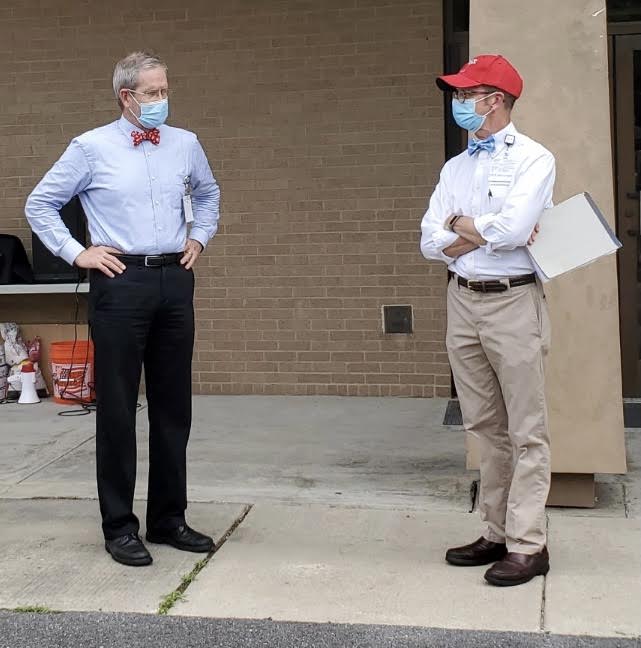
Early in our time as the Baltimore Convention Center Field Hospital (BCCFH) COVID Contingency hospital I started wearing a bow tie to work every day. My co-director Dr. Jim Ficke and I made the decision together and it became something of a trademark for us as we worked in the various testing, vaccination and treatment sites across Baltimore and Maryland. We joked with the staff that if anyone had a complaint, they should tell them to look for one of the guys with a bow tie. We got plenty of feedback from our patients. But it was largely compliments about our team rather than criticism. Several of the other executive leaders also wore bow ties as they came on board. They thought it was part of the uniform.

The tie is part of a larger set of lessons about professionalism that I have been learning throughout my health care career. A med school professor told me that he never wore blue jeans to the hospital because he didn’t want to create too casual an impression with patients. Since then, I haven’t either. I started wearing bow ties as a medical student when I decided on a career in pediatrics because I thought they were less likely to get urinated on than a neck tie. (The latter have been suspected of carrying pathologic bacteria. Though disputed, it’s another reason for a bow tie preference). Continue reading

Leave a comment

Filed under Organizational Leadership, Uncategorized

The Bat-Phone and Leader Presence

Recently I had the opportunity to speak to the mother of an infant hospitalized with respiratory illness in a hospital in another state. She was the daughter of a friend of a relative but it was a joy to speak to her, talk through some of her concerns and reassure her that from what she was telling me, she was in good hands. (Her baby did well!)

In the course of the conversation, I remembered that I knew a senior physician at the hospital and I send him a quick text. By the time I caught up with him a little while later, he had already been to the patient’s room. He missed the baby’s mother but left his card with his cell-phone number in case she needed anything.

His generous gesture reminded me of the “Bat-Phone” we instituted when I was a hospital CEO (Commander) a decade or so ago. I am relatively sure that I stole the idea from Quint Studer or another of the quality and patient experience gurus to whom we owe so much of the great things we were able to do at that facility while we were shaping a “Culture of Excellence.” We shared the Bat-Phone cell phone number with all of our staff, our hospitalized and ambulatory patients – probably thousands of people. I carried the phone with me every day. It was a visible symbol of our efforts to be accessible to our staff and patients. In addition to the phone number, we also had a link on our public and internal websites where people could reach out to the CEO by email directly. Continue reading

6 Comments

Filed under General Leadership, Personal Leadership, Uncategorized

“Is this your field hospital?”

“Is this your field hospital?”

This question is the reason I wear a tie to all our COVID testing events. I want people to know where they can direct complaints or concerns. I walked over to the gentleman who asked the question and steeled myself for “constructive feedback.”

It has been six months of almost exclusively COVID. Since mid-winter and my taking the role of Hospital Incident Command’s “Community Liaison,” the population health job has taken on a very specific focus as COVID has become the latest of the threats to the health for our community.

We started in early March by planning for hospital COVID testing and working with community health on food distribution after the schools closed and many of the children in the community lost access to several of their daily meals. By mid-month, a group of us from the two largest medical systems in our city met with the State Health Department and were directed to construct and operate a FEMA field hospital in the convention center. Continue reading

6 Comments

Filed under Organizational Leadership, Uncategorized

Learning Leadership in the City

Ten TwelveOn a clear, breezy summer Saturday morning in the Sandtown-Winchester neighborhood of Baltimore, 10:12 Sports Director Jeff Thompson speaks to a young player about character in the context of a flag-football game. In the background, the Ravens and the Bengals play the fifth game of their season.

In this neighborhood, 60% children live below the poverty level, 80% of households with children under 18 are female-headed, unemployment is 17% and a quarter of kids never finish high school. The field where the young men play is half a mile from the scene of the uprising and violence surrounding the death of Freddie Gray in 2015.

This is the neighborhood where Jeff Thompson and his volunteers work with young men teaching the fundamentals of character and leadership from a Christian perspective. The lessons are framed against the backdrop of a flag-football league that also employees local youth on weekends as referees, linesmen, and statisticians.

Character is the foundation of almost any leadership model. The ability to “lead self” is crucial before one can attempt to apply almost any other leader competency. There’s much that a developing leader can read about the importance of character and no shortage of books on the subject. But no book can teach what we learn from credible mentors who serve as examples and who listen to understand.

Albert Schweitzer said, “Example is not the main thing in influencing others, it is the only thing.” Leadership guru Michael Useem took that same idea one step further: “Leadership is best learned from example and best communicated through example.”

Still a relative newcomer to Baltimore, I have joined the search for the magic, missing ingredients that once applied will cure the city’s woes. I know already that there isn’t any single thing. But on this Saturday morning these young men – in the context of a community who loves and cares for them and who holds them accountable for their actions – were experiencing the closest thing I have found to a foundational first step.

“Leadership is character in motion” (Les Csorba).

For these young men on any given Saturday there is more in motion than the football and the players on the field.

Chuck Callahan Henry V 4.3 – Lead from the Front      https://henryv43.wordpress.com/

2 Comments

Filed under General Leadership, Personal Leadership

Reflection: The Leader’s Gift – Presence

If the currency of the economy of relationship is trust, the currency of leadership is presence. To “be there” at the critical moment for an individual, a team or an organization is the essence of a leader’s effectiveness. Presence requires of the leader attention and intention. Good leadership is always intentional and “attentional.”

When I was helping to lead a community hospital in Virginia a decade or so ago I decided to count through the course of day every single human interaction I had – in person, in the hallway, in an executive or hospital meeting; by phone, email or text. I carried a 3×5 card and made little pencil tick-marks throughout the day. At the end of the 18 hours or so of measurement I counted 283 pencil marks: 283 encounters. The requirement for me as the leader to be present, attentional and intentional was not daunting or infinite. It was in fact finite and consisted of scores of opportunities to be present, to be listening, to be attentive – to “be there.”

The Egyptian philosopher Ptahhotep wrote in the 24th century BC, “Those who must listen to the pleas and cries of their people should do so patiently, because the people want attention to what they say even more than the accomplishing for which they came.”

Being there is a privilege bestowed on the leader never to be taken for granted.

There is a greeting among the people of Northern Natal in Africa when they meet someone, make eye contact and resolve to be present: “Sawu Bona – I see you.”

The reply is an equal commitment to attention and intention: “Sikhona – I am here.”

I see you. I am here.

These are perhaps the most important words we can live by for the men and women we have the privilege to lead.

Chuck Callahan Henry V 4.3 – Lead from the Front      https://henryv43.wordpress.com/

1 Comment

Filed under "The Spirit of the Student", General Leadership, Uncategorized

First person, singular.

When I was a fellow one of the senior physicians at the children’s hospital where I trained approached me with a question:

“Dr. Callahan,” (she was always pretty formal). “Does your colleague Dr. Christopher have his own lab?”

“No ma’am” I replied (formal, too). “He works in the same labs we all do. Why do you ask?”

“Well in speaking with him he often refers to ‘his lab’ and I was just wondering whether the fellows actually had their own labs.”

We didn’t. I started to listen more carefully and noticed that Dr. Christopher (not his real name) had a tendency that afflicts many in leadership: the over-use of the first person (“I, me, my”). I acknowledge it is nowhere near as grating as referring to oneself in the third person (“Bo Jackson has to do what’s best for Bo Jackson”). But it is something I have noticed through the years, possibly a function of my own fear that I might sometimes lean in the same direction. Certainly positions of leadership can foster that way of thinking. People pay a great deal of attention to leaders wherever and whatever they are doing. They even notice and may comment on what the leader’s wearing (“Sir, I notice you wear Tom’s”). Perhaps that is why General George Patton said that leadership was theater. The leader is always on stage.

But it is too easy to succumb to the cult of the first person and increasingly cast our shadow over all we’re associated with: my team, my assistant, my hospital, my staff, my directorate, my lab. Pay attention to your own patterns of speech and see how many times you refer to yourself.

It would only be a bad habit if it weren’t for one thing. We may have bought into the traditional “heroic” model of leadership. The model is common in ancient literature. Leaders were known for their physical size, strength, or looks; individual personality traits or charisma. For example in Homer’s epic poem Achilles was a leader because of his demigod warrior status, Ajax as a result of his size and strength, and Hector because of his courage and dedication to his people. Early leadership theory focused on the leader and the leader’s persona.

Scottish writer Thomas Carlyle wrote in his book (the title is telling): On Heroes, Hero-worship, and the Heroic in history (1840), “For as I take it, Universal History, the history of what man has accomplished in this world, is at the bottom the History of the Great Men who have worked here.” His emphasis on the individual leader gave rise to the “Great Man” theory of leadership.

The problem is that we have entered an era of horizontal leadership where the best leaders are the best listeners; they are willing to relinquish power to accomplish goals, have the greatest ability to form and facilitate teams, and have the greatest emotional intelligence. The sun is setting on the great person theory (the traditional messianic or apocalyptic view we hold towards the occupant of the White House seems to be a persistent exception).

We should check ourselves. Excessive use of first person pronouns may reveal a tendency toward seeing ourselves in the “great man” or “great woman” spot light, to the potential detriment of our relationships with peers and subordinates who comprise the teams who really do the work.

The leader without a crowd following him; traveling and working with him, is simply taking a walk. We can too easily end up thinking “first person, singular” when we need the entire team – “first person, plural” – to get the job done.

Chuck Callahan Henry V 4.3 – Lead from the Front      https://henryv43.wordpress.com/

2 Comments

Filed under General Leadership, Personal Leadership, Uncategorized

The sound of the guns

I probably shouldn’t look at social media during church. But honestly, I was just opening the Bible App on my phone (!) The local “Nextdoor” link on my email was a post from someone living nearby: “Neighborhood too dangerous.” The author wrote, “We were talking about how annoying it is that we cannot walk outside without fear of being held up at gunpoint and it might be time to move to a safer place…”

It has been something of a bad week for our neighborhood. Someone was held up and robbed on the street I walk to work and a young man was shot a few blocks from our home. But none of this is new to West Baltimore or to the city where more than three dozen people have been killed since New Years. Perhaps it was just a little too close to home.

The post made me think of our pastor.

He was born and raised in Baltimore and despite growing up in one of the city’s toughest neighborhoods in a single parent home he has a college degree and is among the best read men I know. He had every reason and every opportunity to move away from the conditions in a city that Hobbes would likely agree are “solitary, poor, nasty, brutish and short.”

But he didn’t leave. Instead he studied, trained and prayed and with his wife planted a church in West Baltimore within a mile of the highest density of gun violence in the city. He was with the line of pastors at the uprising after the events surrounding the death of Freddie Gray two years ago this spring. He leads by example in the city of his birth that he could easily and justifiable have left behind.

This morning I was stuck by what drew me to his leadership and to this church.

We spent thirty years in the Army where among the highest virtues was the willingness to run toward the sound of the guns.

Now we are serving with this leader and these brothers and sisters who have chosen to do the exact same thing – literally and figuratively – on some of our nation’s most dangerous streets.

A couple commented at a dinner recently that it is not uncommon in our neighborhood to hear gunshots at night. These men and women whose church meets in a local public school; who are led by a courageous pastor and his wife are far more familiar with the sound than we are.

Perhaps I am drawn to this leader by the same qualities I have long recognized in those with whom I served in uniform:

True leaders run toward the sound of the guns.

We have found a community and leaders who live this.

And it feels a lot like home.

Chuck Callahan Henry V 4.3 – Lead from the Front      https://henryv43.wordpress.com/

2 Comments

Filed under General Leadership, Personal Leadership, Uncategorized

Inquiry: an academia and leadership “main thing?”

“The main thing is to keep the main thing the main thing.”

In their 1997 book The Power of Alignment George Labovitz and Victor Rosansky attribute this quote to Jim Barksdale, former CEO of Netscape, (although it may come originally from Stephen Covey’s Seven Habits of Highly Effective People, 1989).  For my three decades of medicine in the uniformed services, the main thing was pretty straight forward: caring for Service Members and their families.  I remember considering a transition to civilian-life at about twenty years into my career.  While paging through the directory of a local hospital I found myself looking at the physicians’ pictures and musing, “I wonder what their ‘main thing’ is?”  I stayed in the military until they told me it was time to go home.  I think that the clear sense of the main thing was a big part of the reason.

Now I have worked in academia for nearly a year.  Part of the adjustment has been trying to answer the same question: “What is academia’s main thing?”  To a newcomer, the university seemed at times to be a random collection of instructors, researchers and research assistants, statisticians, administrators, teachers, clinicians (in medical academia) all circling in parallel orbits.  I could argue that the medical or graduate students were the central focus, but some staff members rarely interacted with the students.  The search for a unifying “main thing” proved elusive.

A possible answer to the question occurred to me recently while I was listening to a post-doc researcher present her work.  She described how each experiment had led to the need for further experiments.  One question answered led to fresh questions unanswered.  It struck me while she was speaking that when academia functions as it should, its “main thing” is inquiry. Continue reading

Leave a comment

Filed under General Leadership, Personal Leadership