Tag Archives: COVID

Bow Ties and Leader Orthopraxy

Early in our time as the Baltimore Convention Center Field Hospital (BCCFH) COVID Contingency hospital I started wearing a bow tie to work every day. My co-director Dr. Jim Ficke and I made the decision together and it became something of a trademark for us as we worked in the various testing, vaccination and treatment sites across Baltimore and Maryland. We joked with the staff that if anyone had a complaint, they should tell them to look for one of the guys with a bow tie. We got plenty of feedback from our patients. But it was largely compliments about our team rather than criticism. Several of the other executive leaders also wore bow ties as they came on board. They thought it was part of the uniform.
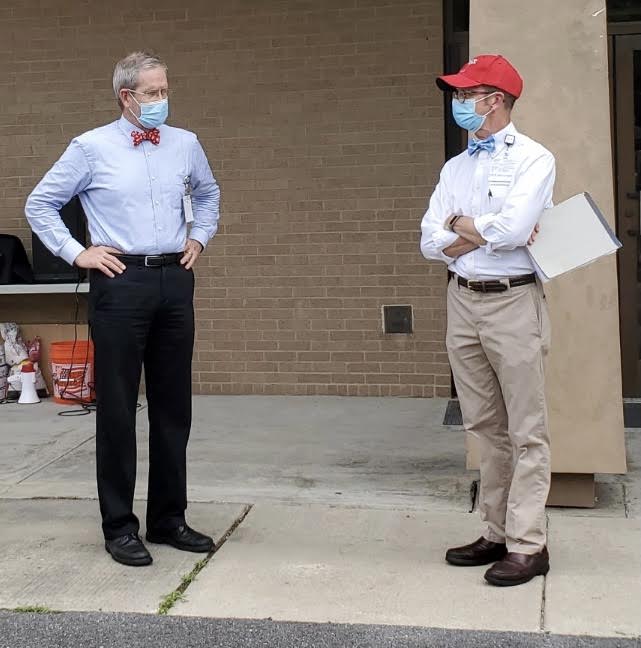
The tie is part of a larger set of lessons about professionalism that I have been learning throughout my health care career. A med school professor told me that he never wore blue jeans to the hospital because he didn’t want to create too casual an impression with patients. Since then, I haven’t either. I started wearing bow ties as a medical student when I decided on a career in pediatrics because I thought they were less likely to get urinated on than a neck tie. (The latter have been suspected of carrying pathologic bacteria. Though disputed, it’s another reason for a bow tie preference). Continue reading

Leave a comment

Filed under Organizational Leadership, Uncategorized

Imperatives of Leadership: A Pandemic Response

“We few, we happy few, we band of brothers…”

The name of this website was inspired by an article on leadership based on two books by Sandhurst military historian John Keegan. The Face of Battle was his 1976 analysis of major battles in history including Agincourt (October 27, 1415). His 1987 book The Mask of Command highlighted styles of military leadership through history and concluded with five of what Keegan considered to be the “Imperatives of Leadership:” kinship, prescription, sanction, action, and example. The 1998 article examined Shakespeare’s speech by Henry at Agincourt (Henry V, Act 4, Scene 3) as an example of Keegan’s leadership imperatives.

In the early spring of 2020 as the COVID pandemic gained momentum, US Army Colonel (Retired) Dr. Jim Ficke and I were asked at the behest of the Governor to stand up a field hospital in the Baltimore Convention Center with a number of leaders from Johns Hopkins Medicine, the University of Maryland Medical Center and the Maryland Department of Health.

Fifteen months later the team concluded inpatient operations after providing care for 1,495 inpatients with COVID. Along the way (and often with short notice) we added missions including a mass COVID testing capability and later numerous community sites that have performed more than 110,000 tests to date. Monoclonal antibody infusions were added in the autumn of 2020 and more than 2,300 have been provided since. And finally, when vaccines became available,  a large-scale vaccination center was opened that has provided more than 122,000 vaccinations since February 2021. The Baltimore Convention Center Field Hospital (BCCFH) is almost certainly the longest continually operating convention center COVID hospital in the nation, and probably the only one where the same team also provided ambulatory infusion treatment, large scale COVID testing and vaccination.

In retrospect, Keegan’s imperatives of leadership were the standard as we established and operated the hospital. In many ways, they were key elements of its success. Continue reading

3 Comments

Filed under Organizational Leadership, Personal Leadership

“Of course!”


A PICU nurse said that to me recently. We had just finished doffing and were walking out of the hot zone transition area of the Convention Center COVID field hospital where we worked. We struck up a conversation and at the end of our exchange I thanked her for serving these patients with us. “Of course!” was her reply.

I think I have heard that response more often these days. Perhaps it is cultural or generational (millennial?). Or maybe it’s just a new colloquialism characteristic of the times. I can’t recall whether it was as common before COVID as it seems to be now. But maybe I should just blame that on “COVID time.” (It seems I can’t remember a lot of things from before COVID.)

In the case of this nurse the “Of course!” took on special meaning. We talked about our shared experience working in pediatric intensive care and the special calling it takes to be a nurse in that setting. She told me that she loved taking care of critically ill children, but when this contingency COVID hospital was established she wanted to be a part of it. The unit where she worked couldn’t allow her go to part-time, so she resigned. And she has been a part of caring for the more than 1,300 adults with COVID we have admitted in our past year or so of operation.

She left something she loved to be part of something she felt needed to be done.

In his mid-twentieth science fiction novel “Starship Troopers” (Putnam 1959), Robert Heinlein wrote “Duty is the social equivalent of self-interest.” It is “the basis of all morality.” It strikes me that duty was not something we heard as much about before the pandemic. Attention and devotion to duty seem to be common virtues now. Continue reading

Leave a comment

Filed under Uncategorized

“Is this your field hospital?”

“Is this your field hospital?”

This question is the reason I wear a tie to all our COVID testing events. I want people to know where they can direct complaints or concerns. I walked over to the gentleman who asked the question and steeled myself for “constructive feedback.”

It has been six months of almost exclusively COVID. Since mid-winter and my taking the role of Hospital Incident Command’s “Community Liaison,” the population health job has taken on a very specific focus as COVID has become the latest of the threats to the health for our community.

We started in early March by planning for hospital COVID testing and working with community health on food distribution after the schools closed and many of the children in the community lost access to several of their daily meals. By mid-month, a group of us from the two largest medical systems in our city met with the State Health Department and were directed to construct and operate a FEMA field hospital in the convention center. Continue reading

6 Comments

Filed under Organizational Leadership, Uncategorized