Lampstand Leadership

At a certain point in my career I had the opportunity to consider moving from a position that I really enjoyed at an academic medical center to the leadership team of a small but very busy community hospital.  While the chance to move was an exciting opportunity, I was very attached to the people and the mission of the medical center.  It was a tough decision that I have to admit I agonized over a bit.  Many of my friends provided good counsel.  In the end, it was a principle from the New Testament of the Bible that ultimately guided the decision; a move that proved to be one of the greatest experiences of my life.

In the first century, the world was a pretty dark place.  In today’s world with electric lights everywhere, I don’t think that we don’t appreciate how dark it really was (a point made very well in William Manchester’s book, “A World Lit Only By Fire.”)  After sunset in the Middle East, the only light in a home came from small lamps, usually burning olive oil.  Jesus used this metaphor to describe the influence he expected his followers to have in the world.  “You don’t put a lamp under a basket” he argued.  “You put it on a lampstand so that it will provide light for all in the room.”

Leadership is like a lampstand.  If we believe that the call to lead is in fact a vocation and not merely an occupational sidebar or career necessity, then the influence we have as leaders can be thought of as light.  And as we move to higher positions of authority and responsibility, we are moving to progressively higher lampstands.  A higher lampstand provides the chance for us to have greater influence.  But it also comes with risks.  At least four come immediately to mind:

It’s hard to keep lit the lamp lit.  It’s tough to get oil to the lamp way up there.  If you think of the kinds of things that keep us encouraged and excited about the work we do, the higher the lampstand, the harder it is to keep that level of excitement.  From a higher position it is much easier to see everything that is wrong with a situation.  And so it can be easier to become discouraged.  It is also lonelier.  You have fewer peers, and fewer people with whom you can “let your hair down.” Continue reading
1 Comment

Filed under Personal Leadership

Inbox Urgency: An executive “core competency”

Managing the inbox is a “core competency” for leaders in any profession.  I learned this term from Dr. Mark Kobelja, who worked with me a few years back until he moved to be COO of another facility.  His desk was always clear.  His inbox was generally empty.  I admired his efficiency and candor about inboxes in general.  Unfortunately, with the explosion of the number of different executive inboxes, this “core competency” has become  a challenging imperative.  In the healthcare business, there is a physical inbox on the desktop, an email inbox (sometimes more than one) inboxes for the electronic processing of staff vacation and time off, an electronic system for staff evaluations, and one for checking and verifying staff credentials.  All have to be managed. But probably the most challenging is the email inbox.

Management can be thought of as directing “process and product.”  Electronic mail must be managed. The steps we take to manage email processes proactively will help make us more efficient and effective.  As we will see, these steps may not make us better leaders.  Business pundits have offered a range of strategies for email management, so I am sure that these suggestions will generate discussion and additional ideas:

You don’t have to open every email. Set up the view panel – you can scan the contents to see if you need to spend time with it.  Often you don’t have to. In fact, some email doesn’t have to be read at all.  Get into the habit of tossing things that are sent “shotgun” or as general announcement if you already know the subject. Continue reading

1 Comment

Filed under Personal Leadership

Time, Energy and Focus: What are the limits?

Time, energy and focus are finite.  When we chronically try to do more than these limited resources allow, we end up doing everything less well.  For example, we may prioritize and devote what resources we have toward our work, and we end up feeling vaguely guilty because we have little left to contribute at home.  Or we too easily to allow professional demands to squeeze out our interests and hobbies, and pretty soon we find that we are not doing anything for fun.

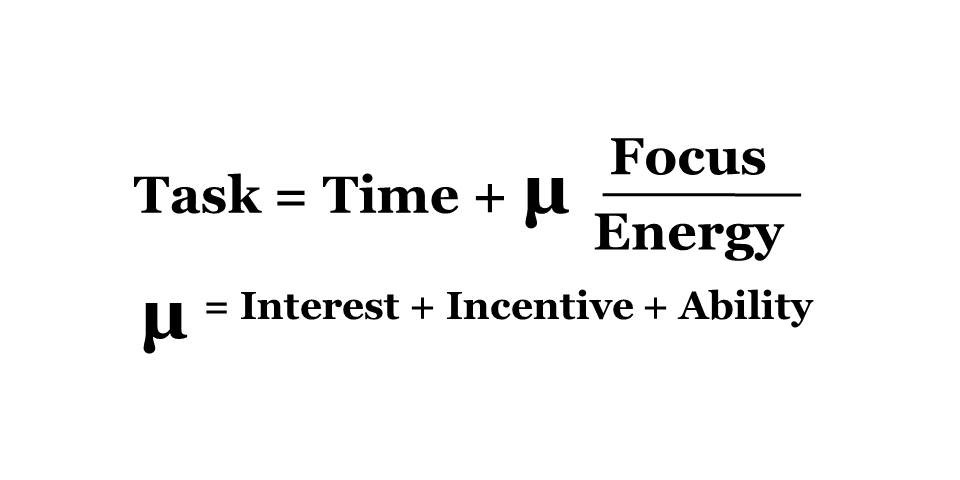
To any task we bring to bear our time, energy and focus.  The equation is “modified” by our personal “mu:” our interest in the task, incentive to finish the task and the ability we have to get the job done.  If we have great interest, incentive or ability, they combine to increase the effect of our focus and energy. So for any given amount of time, our “mu” can increase effectiveness in accomplishing a task.

Focus is our ability to pay attention.  And it is more threatened than ever in this over-stimulated world because of our mistaken notion of multi-tasking.  We are all wired to be able to multi-task.  Picture a basketball guard bringing the ball down the court.  She is dribbling with one hand and then the other, scanning the court, listening to the coach, thinking of possible plays and choosing one, calling the play with a gesture of her non-dribbling hand, alluding the full-court press and running.  That is multi-tasking.  She is using a full spectrum of different nerve pathways simultaneously. Continue reading

Leave a comment

Filed under Personal Leadership

Tactical Medical Leadership

Medicine is intrinsically tactical.  At its core are the single patient and provider in an exam room, at the hospital bed or in the operating room.  The expert clinician is recognized to be expert primarily by his or her tactical prowess.  It is true that the successful provider eventually learns that operational coordination with the health care team across the boundaries is essential for optimal care outcomes. But it begins with the tactical exercise of one-on-one clinical care.

It is also true that at some level, strategic leadership is everyone’s business.  Determining personal “strategic” goals and objectives both personally and professionally should be every leader’s priority. But in a health care system, overarching strategic planning is the purview of the CEO, the board of directors and for the military, the colonels and generals.  Operational leadership fosters coordination between services and departments.  This role belongs to vice presidents, deputies, chairs and chiefs, and to our majors and lieutenant colonels.  Their work is coordinating between services and corps to get work done across different disciplines.

But all of these more senior leaders enable the work of the clinician, the nurse, technician and provider, our enlisted or our junior officers.  These are our specialists, lieutenants, captains and the younger majors– at the bedside, in the OR and the clinic.  If American medicine in general and military medicine in specific are leaning forward at the very precipice of rapid evolutionary or even cataclysmic change, it is these tactical officers who will lead us forward.  So to these staff members belong the future of medicine.  They are the backbone of our clinical systems.  As a lifelong student of leadership, how can I advise them?  To you graduates, how can I encourage you to focus your energy?  How can you become the very best leaders in your “spheres of influence?”  I think that the key will be for you to focus on these three things:

Competence.  First, you must excel at what you do.  Our patients and your peers assume that you are competent. You have to be more than that honestly, because to say a provider is “competent” is tantamount to an insult. You have to be the very best that there is in your specialty.  You must go beyond being just board certified and be the very best. This level of competence goes beyond just being good at doing what you learned how to do.  You should always be looking for better ways to do things. Don’t become married to the ways things have been done, no matter how persuasive your mentor.  Just because it works doesn’t mean it works the best.  Every shred of evidence-based medicine has taught us that we must constantly seek the best, most efficient, highest quality – and least expensive and least variable – way of executing your clinical processes. Find it. Continue reading

1 Comment

Filed under General Leadership

Leadership as Theater

Leadership is theater.

Why does this notion make us uncomfortable?  Is it because we think of acting as make-pretend and we have to grapple with the idea that leadership could somehow be “an act?”  Is it an obscure connection to the Classics, with the reference to theater reminiscent of the two Greek masks of comedy and tragedy?  Or perhaps it is the notion that the Greek name for a stage actor is the source of the English word “hypocrite” something we would never choose to be.  Aside from its common English implication, the word’s Greek derivation also implies someone who goes off script with improvisation, or sometimes who demonstrates less than (“hypo”) wise judgment or discernment (“krinein”).

“Acting is not pretending” according to the author Fred Lee (9 ½ Things You’d Do Differently if Disney Ran Your Hospital) in his book about customer service in health care.  The principle also applies to leadership.  Good leadership is not pretending.  It is authentic – or it is not good leadership.   But it is acting: an intentional process of embracing the role, and recognizing that as leaders we are always “on stage.”

Lee says, “All successful drama is a transforming experience.”  The notion of drama as transformational applies to the work of hospitals and health care facilities.  These are places that consistently provide transforming experiences that engage people on an emotional, physical, intellectual and spiritual level.

Effective leadership accomplishes the same thing. Leaders create transforming experiences for their people proactively or in in response to circumstances every day.  Some experiences are scripted (public speaking, company emails or newsletter columns.)  Some are pure improvisation (the hallway drive-by, the unexpected crisis.)  In every case the leader creates experiences by acting the part, and so shapes reality in the workplace by consciously and consistently being the character, and not by pretending to be someone that he or she is not. Continue reading

Leave a comment

Filed under Personal Leadership

Shaping the Leadership Climate

The soul of an organization, its personality, attitudes habits and behaviors, is its culture.  The way that the organization “feels” to the people who work there and to guests is its climate.  Organizational climate is shaped by many forces, but it begins with leadership.  A healthy leadership climate – reflected in the tone and timbre of the organization – begins when every member of the organization shares three things: respect, reason and risk.

The first characteristic of a healthy leadership climate is shared respect.  The most pervasive chill that can fall over an organization or workplace results when members of the team treat others with scorn or disrespect. It is especially poisonous when the leader is the perpetrator.  The leader who knows his or her job will also know the strengths and weaknesses of all employees.  While strengths should be a matter of public discussion and recognition, weaknesses should not.  An otherwise effective workplace is undermined when the leader speaks ill or criticizes a team member or customer in public.  Praise should be given in public, while “proctoring” – especially if it is to correct a mistake or identify a persistent fault – should be done in private.  The leader should always deliver bad news or criticism in person.  Electronic mail is an unsuitable substitute. Continue reading

4 Comments

Filed under Organizational Leadership

To Lead: An Act in Four “Seens”

Being “seen”

The best thing that a leader can do after taking the reins of an organization is to be seen.  The imperative to be visible also forms the foundation for a set of behaviors that will maintain success throughout a leader’s tenure.  As a resident training at Walter Reed in the eighties, I recall passing by the Deputy Commander of the hospital in the hallway once.  And the only time that I saw the Commanding General was when I was summoned to his office to account for the misbehavior of some of my peers.  It is unfortunate, because I missed opportunities to be inspired by these two great men.  The fact that I can remember these chance meetings three decades later underscores the potential significance of every time  a leader is seen.

Seen seeing.

Every leader must be “seen seeing.”  Many leadership pundits call this “leadership by walking around.”  It is amazing how much the leader can learn by seeing the workings of the organization.  From a practical standpoint, spend an hour or two early every work-week walking around all of the areas of your responsibility.  Talk to the people you meet.  Get to know the people by their names.  Ask them for suggestions of how things might be done better.  Make sure that they have what they need.  And towards the end of the work-week, try to dedicate the time to do it again.  Show up in the areas during off hours.  If you are in the hospital on a weekend, take a few moments to walk through the different areas unexpectedly.  And certainly if there has been a problem: a difficult patient, a sudden patient death or deterioration, the leader must be there soon after.  These are the equivalents of the medical “battle,” and the leader must be at the “con” during battle.  The leader need not take control of the ship, but rather should support those who are in charge, whether things have gone well or not.  And if there has been an error, the leader’s presence reminds that he stands alongside those who have erred as a support, and as the one who is ultimately responsible.   Continue reading

3 Comments

Filed under Personal Leadership

Leadership: Three Assumptions

Leadership experts aren’t. Leadership should be a matter of lifelong study.  Leaders (those who end up in positions of responsibility and authority) should be students of leadership (the ability to motivate a group of people toward a common goal.)  To be a lifelong student means that one has never quite arrived at the level of leadership “expert.”  There are always more lessons to learn.  Be wary, therefore about those who tout to be leadership experts.  It is much more of a journey than a destination. Continue reading

3 Comments

Filed under General Leadership