Category Archives: Personal Leadership

Virtus: The Leadership Foundation

In a recent leadership discussion, a young officer asked what she could do to develop leadership skills even though she didn’t yet hold a leader position.  The answer struck to me right away, and I have been thinking about it since.  Leadership begins and ends with character.  It is something that we can work on throughout our lives.  The Romans used the Latin word “virtus” to refer to character.  The term was used of men and women, and meant to act with courage, with fortitude, and to act like a man (“vir:” Latin for man).  Virtus or character is something that you can focus on whether you’re four, fourteen or forty.  It is the foundation of all successful leadership because it is the fountain from which integrity flows, and integrity is the most often cited trait of successful leaders.

It is worth emphasizing that character is a lifelong pursuit.  We never need be stuck with “Well, that’s just the way I am.”  Some traits are harder to change than others and require increasing levels of support and insight from peers, from mentors or perhaps even from behavioral health professionals.  But we can change.

Character is developed in many ways throughout our lives.  It starts with watching and imitating parents and other role models throughout childhood.  I have mentioned before that leadership skills are a matter of “reading, writing and rhetoric.”  There are a number of ways that the leader interested in developing character can grow by reading, writing and reflection…

  • Get your bearings.   Figure out what matters to you, what is important and live like you have figured it out.   If you are not at the point where you can articulate a personal vision and mission statement, this is a great time.  Set aside an hour or two on a quiet morning or evening and write down where you want to go (vision) and how you think that you will get there (mission.)  Include in your thought process principles and values that you think should characterize your actions and attitudes along he journey.  Then share your thoughts with someone you trust. Continue reading
Leave a comment

Filed under Personal Leadership

Things I have learned from Generals…

Several years ago one of my friends was promoted to the rank of general, which in the military is the civilian equivalent of a Senior CEO or Board Chairman.  In the course of a conversation, my friend asked me whether I had any suggestions or advice.  It did not take me long to think though some observations.  I owe a great deal to general officers who took the time to talk to me and to get to know me at crucial moments in my career.  These observations are worth remembering for all of us who are fortunate enough to find ourselves in positions of leadership.

1. Walk the halls alone.  Years ago I knew a colonel who became a general.  We were friends, although he was older.  Once he was promoted, I never saw him again without his aide or deputy or someone.   It is probably an unfair assessment, but it seemed as though he always had to have an audience for whom he was performing. It didn’t play too well with us.

2. Remember me.  As a young doctor, I was walking down the hallway of my community hospital and a general called out to me and greeted me by name.  She had met me exactly once in a previous job when she was my hospital’s Chief Nurse.  And here, two years later, she remembered my name.  That was huge.  I wish I knew how she did that…

3. Bring me in.  When I was a new subspecialist the hospital commander called me to his office, invited me to be part of some presentations, and gave me a glimpse of life at a higher level.  It was a watershed for me to begin thinking beyond the tactical level.  I wonder if he knew the seeds that he was planting.  Continue reading

1 Comment

Filed under Personal Leadership

Lampstand Leadership

At a certain point in my career I had the opportunity to consider moving from a position that I really enjoyed at an academic medical center to the leadership team of a small but very busy community hospital.  While the chance to move was an exciting opportunity, I was very attached to the people and the mission of the medical center.  It was a tough decision that I have to admit I agonized over a bit.  Many of my friends provided good counsel.  In the end, it was a principle from the New Testament of the Bible that ultimately guided the decision; a move that proved to be one of the greatest experiences of my life.

In the first century, the world was a pretty dark place.  In today’s world with electric lights everywhere, I don’t think that we don’t appreciate how dark it really was (a point made very well in William Manchester’s book, “A World Lit Only By Fire.”)  After sunset in the Middle East, the only light in a home came from small lamps, usually burning olive oil.  Jesus used this metaphor to describe the influence he expected his followers to have in the world.  “You don’t put a lamp under a basket” he argued.  “You put it on a lampstand so that it will provide light for all in the room.”

Leadership is like a lampstand.  If we believe that the call to lead is in fact a vocation and not merely an occupational sidebar or career necessity, then the influence we have as leaders can be thought of as light.  And as we move to higher positions of authority and responsibility, we are moving to progressively higher lampstands.  A higher lampstand provides the chance for us to have greater influence.  But it also comes with risks.  At least four come immediately to mind:

It’s hard to keep lit the lamp lit.  It’s tough to get oil to the lamp way up there.  If you think of the kinds of things that keep us encouraged and excited about the work we do, the higher the lampstand, the harder it is to keep that level of excitement.  From a higher position it is much easier to see everything that is wrong with a situation.  And so it can be easier to become discouraged.  It is also lonelier.  You have fewer peers, and fewer people with whom you can “let your hair down.” Continue reading

1 Comment

Filed under Personal Leadership

Inbox Urgency: An executive “core competency”

Managing the inbox is a “core competency” for leaders in any profession.  I learned this term from Dr. Mark Kobelja, who worked with me a few years back until he moved to be COO of another facility.  His desk was always clear.  His inbox was generally empty.  I admired his efficiency and candor about inboxes in general.  Unfortunately, with the explosion of the number of different executive inboxes, this “core competency” has become  a challenging imperative.  In the healthcare business, there is a physical inbox on the desktop, an email inbox (sometimes more than one) inboxes for the electronic processing of staff vacation and time off, an electronic system for staff evaluations, and one for checking and verifying staff credentials.  All have to be managed. But probably the most challenging is the email inbox.

Management can be thought of as directing “process and product.”  Electronic mail must be managed. The steps we take to manage email processes proactively will help make us more efficient and effective.  As we will see, these steps may not make us better leaders.  Business pundits have offered a range of strategies for email management, so I am sure that these suggestions will generate discussion and additional ideas:

You don’t have to open every email. Set up the view panel – you can scan the contents to see if you need to spend time with it.  Often you don’t have to. In fact, some email doesn’t have to be read at all.  Get into the habit of tossing things that are sent “shotgun” or as general announcement if you already know the subject. Continue reading

1 Comment

Filed under Personal Leadership

Time, Energy and Focus: What are the limits?

Time, energy and focus are finite.  When we chronically try to do more than these limited resources allow, we end up doing everything less well.  For example, we may prioritize and devote what resources we have toward our work, and we end up feeling vaguely guilty because we have little left to contribute at home.  Or we too easily to allow professional demands to squeeze out our interests and hobbies, and pretty soon we find that we are not doing anything for fun.

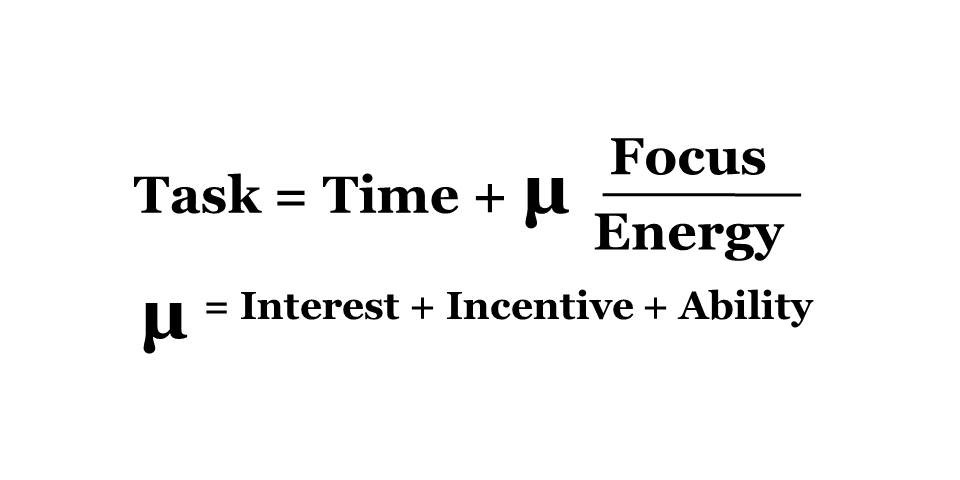
To any task we bring to bear our time, energy and focus.  The equation is “modified” by our personal “mu:” our interest in the task, incentive to finish the task and the ability we have to get the job done.  If we have great interest, incentive or ability, they combine to increase the effect of our focus and energy. So for any given amount of time, our “mu” can increase effectiveness in accomplishing a task.

Focus is our ability to pay attention.  And it is more threatened than ever in this over-stimulated world because of our mistaken notion of multi-tasking.  We are all wired to be able to multi-task.  Picture a basketball guard bringing the ball down the court.  She is dribbling with one hand and then the other, scanning the court, listening to the coach, thinking of possible plays and choosing one, calling the play with a gesture of her non-dribbling hand, alluding the full-court press and running.  That is multi-tasking.  She is using a full spectrum of different nerve pathways simultaneously. Continue reading

Leave a comment

Filed under Personal Leadership

Leadership as Theater

Leadership is theater.

Why does this notion make us uncomfortable?  Is it because we think of acting as make-pretend and we have to grapple with the idea that leadership could somehow be “an act?”  Is it an obscure connection to the Classics, with the reference to theater reminiscent of the two Greek masks of comedy and tragedy?  Or perhaps it is the notion that the Greek name for a stage actor is the source of the English word “hypocrite” something we would never choose to be.  Aside from its common English implication, the word’s Greek derivation also implies someone who goes off script with improvisation, or sometimes who demonstrates less than (“hypo”) wise judgment or discernment (“krinein”).

“Acting is not pretending” according to the author Fred Lee (9 ½ Things You’d Do Differently if Disney Ran Your Hospital) in his book about customer service in health care.  The principle also applies to leadership.  Good leadership is not pretending.  It is authentic – or it is not good leadership.   But it is acting: an intentional process of embracing the role, and recognizing that as leaders we are always “on stage.”

Lee says, “All successful drama is a transforming experience.”  The notion of drama as transformational applies to the work of hospitals and health care facilities.  These are places that consistently provide transforming experiences that engage people on an emotional, physical, intellectual and spiritual level.

Effective leadership accomplishes the same thing. Leaders create transforming experiences for their people proactively or in in response to circumstances every day.  Some experiences are scripted (public speaking, company emails or newsletter columns.)  Some are pure improvisation (the hallway drive-by, the unexpected crisis.)  In every case the leader creates experiences by acting the part, and so shapes reality in the workplace by consciously and consistently being the character, and not by pretending to be someone that he or she is not. Continue reading

Leave a comment

Filed under Personal Leadership

To Lead: An Act in Four “Seens”

Being “seen”

The best thing that a leader can do after taking the reins of an organization is to be seen.  The imperative to be visible also forms the foundation for a set of behaviors that will maintain success throughout a leader’s tenure.  As a resident training at Walter Reed in the eighties, I recall passing by the Deputy Commander of the hospital in the hallway once.  And the only time that I saw the Commanding General was when I was summoned to his office to account for the misbehavior of some of my peers.  It is unfortunate, because I missed opportunities to be inspired by these two great men.  The fact that I can remember these chance meetings three decades later underscores the potential significance of every time  a leader is seen.

Seen seeing.

Every leader must be “seen seeing.”  Many leadership pundits call this “leadership by walking around.”  It is amazing how much the leader can learn by seeing the workings of the organization.  From a practical standpoint, spend an hour or two early every work-week walking around all of the areas of your responsibility.  Talk to the people you meet.  Get to know the people by their names.  Ask them for suggestions of how things might be done better.  Make sure that they have what they need.  And towards the end of the work-week, try to dedicate the time to do it again.  Show up in the areas during off hours.  If you are in the hospital on a weekend, take a few moments to walk through the different areas unexpectedly.  And certainly if there has been a problem: a difficult patient, a sudden patient death or deterioration, the leader must be there soon after.  These are the equivalents of the medical “battle,” and the leader must be at the “con” during battle.  The leader need not take control of the ship, but rather should support those who are in charge, whether things have gone well or not.  And if there has been an error, the leader’s presence reminds that he stands alongside those who have erred as a support, and as the one who is ultimately responsible.   Continue reading

3 Comments

Filed under Personal Leadership