
Time, energy and focus are finite. When we chronically try to do more than these limited resources allow, we end up doing everything less well. For example, we may prioritize and devote what resources we have toward our work, and we end up feeling vaguely guilty because we have little left to contribute at home. Or we too easily to allow professional demands to squeeze out our interests and hobbies, and pretty soon we find that we are not doing anything for fun.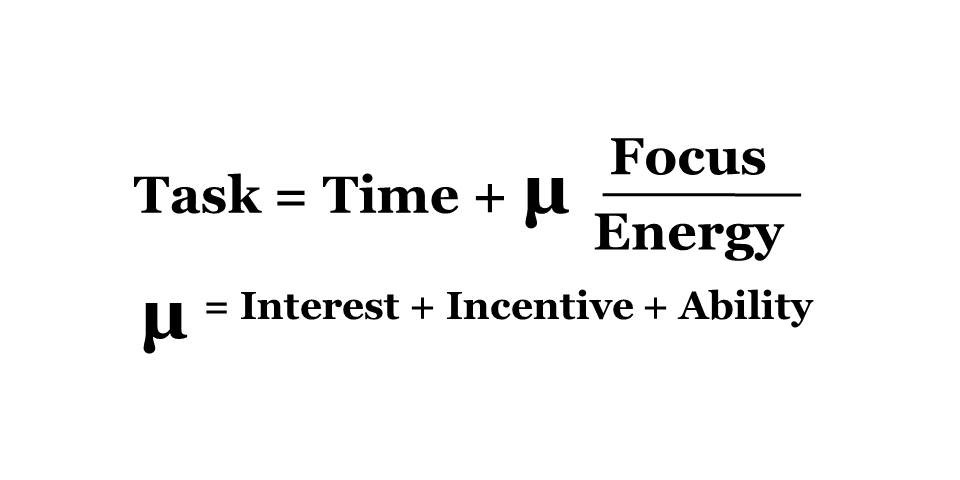
To any task we bring to bear our time, energy and focus. The equation is “modified” by our personal “mu:” our interest in the task, incentive to finish the task and the ability we have to get the job done. If we have great interest, incentive or ability, they combine to increase the effect of our focus and energy. So for any given amount of time, our “mu” can increase effectiveness in accomplishing a task.
Focus is our ability to pay attention. And it is more threatened than ever in this over-stimulated world because of our mistaken notion of multi-tasking. We are all wired to be able to multi-task. Picture a basketball guard bringing the ball down the court. She is dribbling with one hand and then the other, scanning the court, listening to the coach, thinking of possible plays and choosing one, calling the play with a gesture of her non-dribbling hand, alluding the full-court press and running. That is multi-tasking. She is using a full spectrum of different nerve pathways simultaneously.
Most of what we call multi-tasking is really serial mono-tasking in situations where we use the same nerve pathways (“mono-tracking”) in rapid, serial sequence. Consider this example. An executive is sitting in a meeting listening to a presentation, reading the Powerpoint slides and listening to the explanation at the same time. He takes out his Blackberry in response to its buzz, opens it and reads an email. He muses for a minute, smiles and types a quick response. He returns the device to his hip and re-engages with the presentation that has evolved into a series of questions by his peers that he missed while reading his email. The same scenario occurs with a teenage child in conversation with her father while texting with several friends. Like the man in the meeting, she is not multi-tasking. They are both using the same nerve pathways for language reception, interpretation and expression in rapid, serial succession. And in so doing, they limit their ability to really focus on any one.
Ever notice how annoyed you get when someone interrupts you with a question while you are working on email? Electronic mail or “SMS” texting requires the same language skills that we need to hold the conversation. We get vexed because we realize subconsciously that we cannot do both. If we are to be effective we know that we need to turn from the email to focus on the question, or delay a moment in addressing the question while we answer the mail. Focus is finite.
The notion that energy is limited is controversial. Tony Schwartz and Catherine McCarthy in their article “Manage your Energy NotYour Time “ (HBR October 2007) and Schwartz’s book with Jim Loehr The Power of Full Engagement (Free Press, 2003) make a convincing case that by insuring adequate rest, diet, exercise and human interaction while being fully “engaged” we may actually find ourselves with greater bursts of energy to devote to a task. Retired Army Major General Carla Hawley-Boland used to tell her subordinates that they needed to “PRESET:” pray, read, eat, sleep, exercise and think as a means to enhance personal energy. For most of us, our attention to these activities is fixed at any given time, even though we can and should be working to maximize them. We let life get in the way.
Eleanor Roosevelt once said, “All of us have all the time that there is.” We are all equally limited by the 168 hours there are in any given week. If we take on a task that requires a great deal of focus and energy, and we lack the ability, incentive or interest for the job, or we approach it with low energy, feeling exhausted and distracted, it is going to require a great deal more time to accomplish the task with any success. Alternatively, as Schwartz and McCarthy make the point well in their article, the same tasks approached with energy, interest, and focus can be accomplished with a superior result in less time.
It is a simple limitation of the human condition: we can only do so much and can only accomplish so many things at the same time. The tasks demanded of leaders seem limitless. The personal resources available are not. Leaders bring their time, energy and focus into the fight, and they learn to use them judiciously; the best use of the finite to take on the infinite. My friend Loren Lasher from Hawaii first taught me that a very small course change – only a few degrees – has a profound effect on a rocket’s direction over the course of its trajectory. So it is with our lives that a small change of habit or routine can reap a big harvest over time. Begin today. Exercise if you haven’t. Rest if you should. Do something fun if it’s been a long time. Focus on the task at hand. We will all be amazed at how much more we are truly capable of. And we will set the tone for our organizations as well.
 Henry V 4.3